
As an engineer, a significant part of my job is understanding constraints and how they affect a design.
Some constraints are obvious from the beginning. Others don't become apparent until later. Sometimes we discover them through calculations, site observations, or conversations with stakeholders. Sometimes we don't discover them until something isn't performing the way we expected.
The goal isn't simply to create a design that works under known conditions. It's to make reasonable assumptions, account for uncertainty where possible, and incorporate appropriate design margins for what we don't yet know.
Even then, uncertainty remains.
One of the realities of engineering is that we rarely have perfect information. Site conditions may differ from available records. Requirements may change. Assumptions that seemed reasonable during design may later prove incomplete.
That's why investigating problems is often more valuable than simply identifying them.
A Fault Line
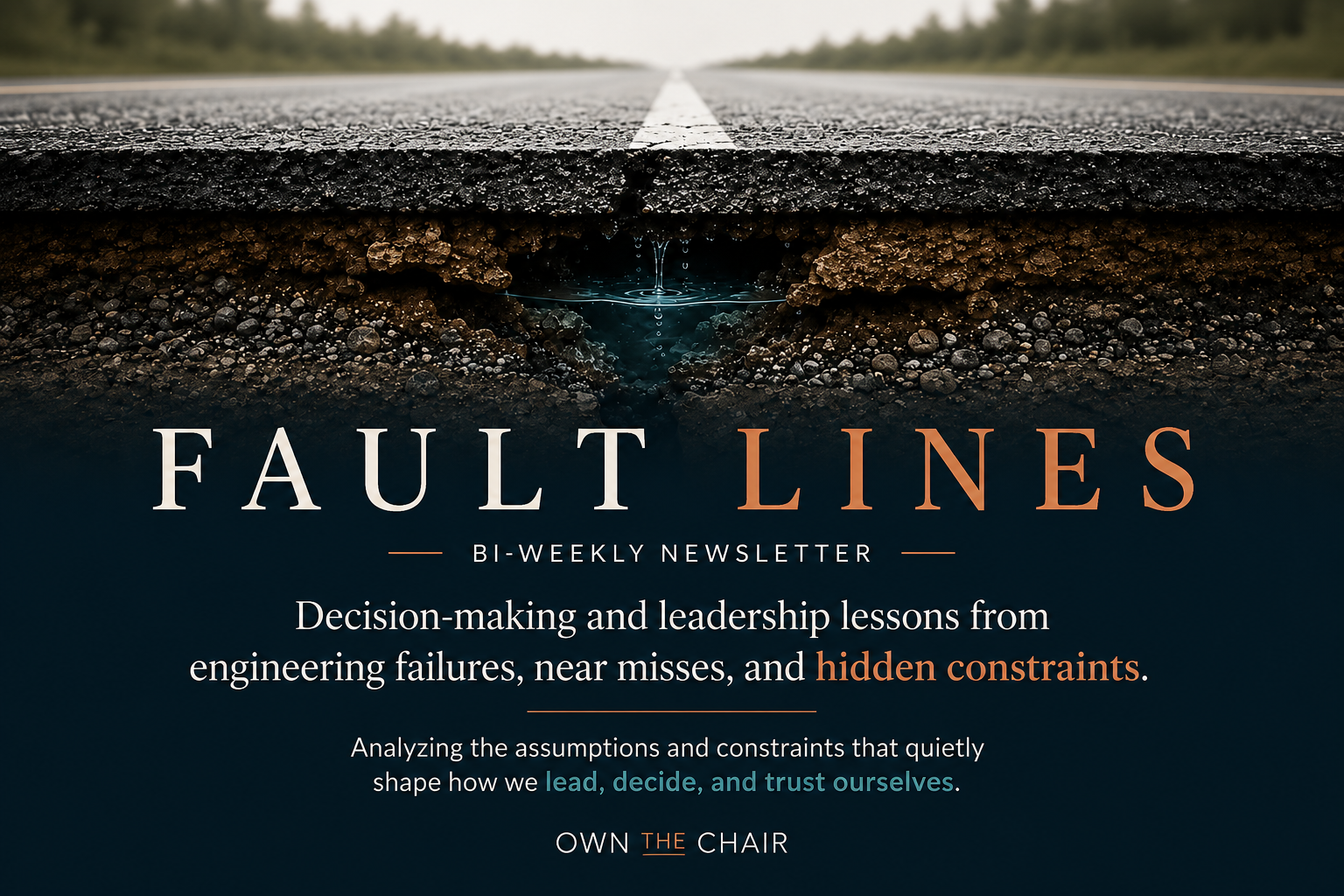
The visible problem is often constrained by factors that remain hidden beneath the surface.
When a structure exhibits signs of distress, we tend to focus on what we can see:
The crack
The settlement
The ponding
The failed component
Those observations are important, but they're usually not where the investigation ends. The more valuable question is:
What conditions contributed to this outcome?
Was an assumption incorrect?
Was a constraint overlooked?
Did conditions change?
Was there information that wasn't available during design?
Over the years, I've come to believe people operate much the same way.
Someone may struggle to make a decision.
Someone else may avoid a conversation they know they need to have.
Another person may find themselves stuck in perfectionism, searching for just a little more information before taking action.
The visible challenge is different in each case.
Yet beneath those challenges, I often see a similar pattern:
Self-trust.
Or more accurately, a lack of it.
Hidden Constraints
The details may vary, but the underlying assumptions often sound familiar:
I need more certainty before I can move forward.
If I make a mistake, I've failed.
Disappointing others will damage the relationship.
My worth depends on what I achieve.
I can only trust myself when the outcome is guaranteed.
The challenge with hidden constraints is that they rarely present themselves as assumptions.
They present themselves as facts.
Over time, we stop evaluating them. We accept them as true and begin making decisions around them.
What started as an assumption gradually becomes part of how we interpret ourselves, other people, and the choices in front of us.
Eventually, we stop noticing the constraint altogether.
My Own Hidden Constraint
For many years, I operated under an assumption that seemed reasonable: achievement would eventually create confidence and fulfillment.
The logic appeared sound. If I continued learning, performing well, and reaching meaningful goals, confidence should naturally follow.
In many ways, the evidence appeared to support that assumption. I advanced in my career, pursued challenging opportunities, and achieved many of the goals I had set for myself.
Yet a pattern kept repeating.
Each accomplishment provided a temporary sense of satisfaction before my attention shifted to the next objective. There was always another milestone to pursue, another area where I felt I should be doing more, or another achievement that seemed just important enough to chase.
Eventually, I began questioning the assumption itself.
Looking back, achievement was never the issue.
The hidden constraint was a belief that my worth depended on what I accomplished.
As long as worth remained tied to achievement, no amount of achievement could fully resolve the question. There would always be another benchmark, another promotion, another goal, or another accomplishment required to reinforce the conclusion.
What I originally viewed as motivation was also functioning as a constraint.
It influenced how I responded to mistakes, how I evaluated my performance, and how much trust I placed in myself when outcomes were uncertain.
Like many hidden constraints, I didn't recognize it because I never questioned it.
A Different Definition of Self-Trust
Today, I've come to think about self-trust differently.
Self-trust is not believing you'll always make the right decision.
It's trusting that you've gathered enough information to move forward. And if the outcome isn't what you hoped for, you'll learn from it, adapt, and make the next decision with more information than you had before.
That distinction matters.
Because certainty is rarely available when we need it most. The decisions that shape our careers, leadership, relationships, and lives often require us to move forward without guarantees.
Self-trust is not confidence that you'll always be right. It's trusting that you'll be okay even when you're wrong.
A Question For You
As you think about your own hidden constraints, consider:
What decision have you been postponing?
What conversation have you been avoiding?
What assumption are you treating as a fact?
What evidence supports that assumption?
What evidence challenges it?
What hidden constraint might be influencing your next step?
Why Fault Lines?
That is the idea behind Fault Lines.
Every two weeks, I'll explore observations from engineering, coaching, leadership, and life. Together, we'll examine the assumptions and hidden constraints that influence how we make decisions, navigate uncertainty, and trust ourselves.
Because the visible challenge is rarely the whole story.
The more interesting question is often:
What is happening beneath the surface?