
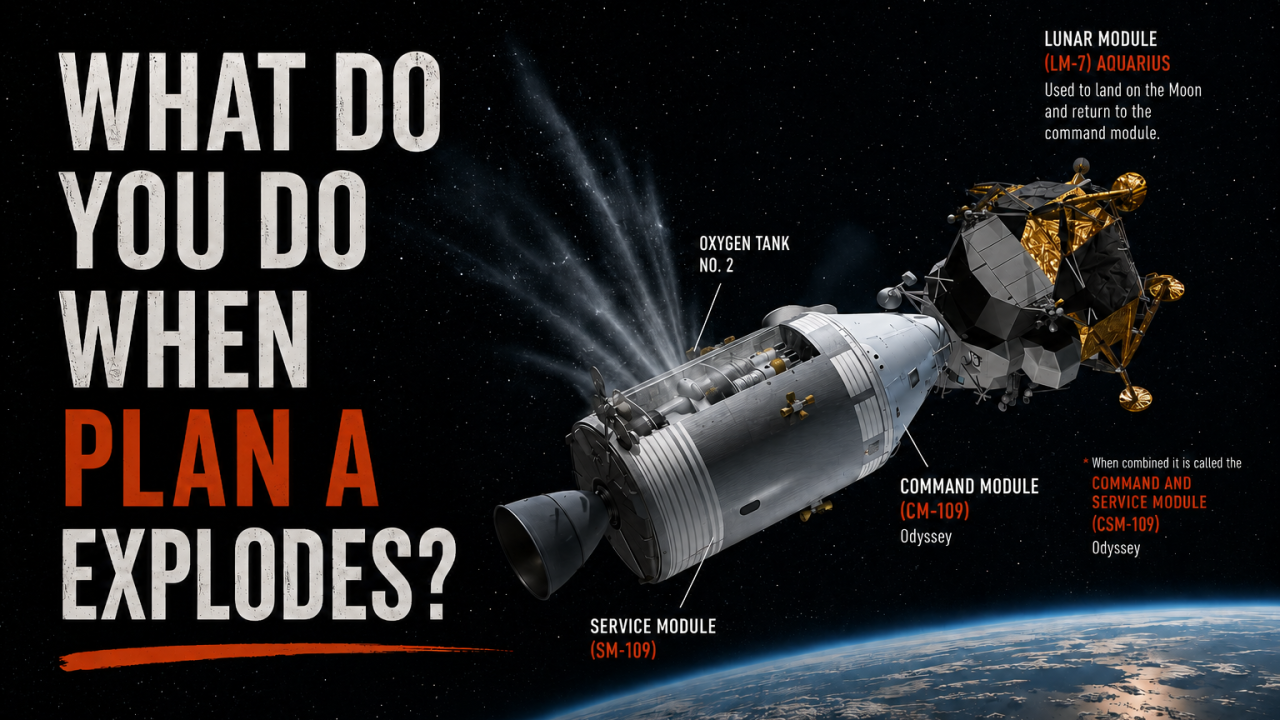
What Apollo 13 teaches us about making aligned decisions when the plan falls apart.
What do you do when Plan A explodes?
Most of us eventually find out.
The details are different, but almost everyone reaches a moment when the future they planned is no longer the future they're living—a layoff, a recession, becoming a caregiver, a health diagnosis, artificial intelligence reshaping an industry, or simply realizing that the career you've spent years building no longer aligns with who you've become.
When Everything Changed
On April 11, 1970, Apollo 13 launched as NASA's third mission to land astronauts on the Moon. Everything appeared to be going according to plan.
Then, just over two days into the mission and nearly 200,000 miles from Earth, an oxygen tank inside the spacecraft's Service Module exploded.
The Moon landing was immediately aborted.
What followed became one of the greatest engineering stories in history.
The Hidden Constraints
The explosion wasn't caused by a single catastrophic mistake. Instead, it was the result of several hidden constraints that quietly accumulated over years.
An oxygen tank had been accidentally damaged during manufacturing but was still considered flight-worthy after inspection.
NASA upgraded its ground testing equipment from 28 volts to 65 volts, but one critical component—the thermostat controlling the tank's heaters—was never redesigned for the higher voltage.
During a pre-launch test, the thermostat failed, allowing the heaters to remain on for hours and raising the tank's temperature to nearly 1,000°F (540°C).
The excessive heat damaged the Teflon insulation protecting the internal wiring, but the available instruments couldn't detect the overheating.
About 56 hours into the mission, a routine check to stir the liquid oxygen activated the damaged wiring, causing a short circuit that ignited the insulation and triggered the explosion.
None of these issues seemed catastrophic on their own. It was only in hindsight that they formed a clear chain leading to failure.
In engineering, failures rarely begin where we first notice them. The visible failure is often the final expression of hidden constraints that have been building beneath the surface for months—or even years.
Life isn't much different.
A layoff may reveal financial instability.
Burnout may expose a life built around other people's expectations.
A promotion may uncover self-doubt.
Redefining the Mission
After the explosion, Mission Control didn't waste valuable time asking:
"How can we still land on the Moon?"
Instead, they asked a different question:
"What gives this crew the best chance of getting home safely?"
That question changed everything.
The Lunar Module, Aquarius, had been designed to carry two astronauts for about two days during the Moon landing. After the explosion, it became an emergency lifeboat, supporting three astronauts for nearly four days on the journey home. Engineers powered down nearly every nonessential system to conserve electricity. Water was rationed. They even built a carbon dioxide filter adapter using only the materials already onboard because the Command Module's square filters didn't fit the Lunar Module's round openings. Every available resource was repurposed to support the new mission.
Every decision was evaluated against one objective:
Get the crew home safely.
Against extraordinary odds, Apollo 13 splashed safely into the Pacific Ocean on April 17, 1970.
The astronauts never landed on the Moon.
Apollo 13 became known as NASA's "successful failure."
The original mission failed. The team succeeded.
Apollo 13 wasn't saved by optimism alone. It was saved by adaptation.
Once the explosion occurred, the original mission was no longer possible. Instead of trying to rescue Plan A, the astronauts and Mission Control accepted the new reality and aligned every decision with a new objective: bringing the crew home safely.
Life often asks the same of us.
When Plan A Explodes, Ask Yourself...
What matters most now?
What resources do I have—internally and externally?
What are the constraints?
What's the next aligned decision?
The Cost of Standing Still
One pattern I see repeatedly in coaching is that people often overestimate the immediate pain of making a difficult decision while underestimating the cost of avoiding it.
When clients come to me, they're often facing an important decision. They want certainty before moving forward.
Their thoughts usually sound familiar:
What if I fail?
What if I disappoint people?
What if I lose my credibility?
What if I make the wrong choice?
What if I regret it?
What if I can't recover if things don't work out?
Those are honest questions, and understandably so. When the future is uncertain, our brains naturally focus on protecting us from immediate pain and potential loss.
The challenge is that those questions only look at one side of the equation.
But every decision has two costs: the cost of action and the cost of inaction.
So I ask two different questions:
What's the cost of waiting?
And then:
What am I willing to pay to create the future I want?
Because every future has a price.
The only real choice is whether you pay the price of change today—or the price of staying the same tomorrow.
Instead of focusing only on what they might lose by making a change, they begin to consider what staying where they are may actually cost them: a leadership opportunity, higher pay, healthier boundaries, more meaningful work, time with loved ones, or simply the fulfillment that comes from living in alignment with what matters most.
Not every decision guarantees those outcomes. But continuing to postpone what matters most often guarantees they remain out of reach.
As engineers, we're trained to evaluate the entire life cycle of a project, not just the immediate construction cost.
Yet when it comes to our own lives, we often do the opposite.
We focus on today's discomfort instead of the long-term cost of standing still.
Designing the Next Mission
Apollo 13 didn't end with splashdown.
NASA spent months investigating every hidden constraint, every overlooked assumption, and every design decision that contributed to the explosion. The purpose wasn't to assign blame. It was to learn and build better systems for future missions.
Our lives deserve the same kind of reflection.
When our own plans fall apart, we can ask:
What assumptions was I making?
What hidden constraints became visible?
What strengths did I discover?
What matters most now?
How will this experience shape my next mission?
We can't redesign the mission we've already flown.
But we can use what we've learned to design the next one.
Redefining Success
Apollo 13 reminds us that success isn't always accomplishing the goal we originally set.
Sometimes success is recognizing that circumstances have changed, uncovering the hidden constraints, redefining the mission, and making the best decisions we can with the information and resources available.
As engineers, we know that when constraints change, the design must change with them.
Our lives and careers are no different.
Change isn't the exception—it's the only constant.
So I'll leave you with three questions:
What decision have you been avoiding?
What is it costing you to wait?
What would become possible if you finally made it?
The ground beneath you will shift.
It always does.
The question is whether you'll recognize when the old design no longer fits—and have the clarity to redefine success, the courage to adapt, and the self-trust to design what comes next.
One aligned decision at a time.